Seeing the Future
A look at the relationship between humans and the future

Recently, I went down a rabbit hole on how to predict the future. In a lot of ways, this has always fascinated me — maybe more so now that a large part of my job is trying to forecast how many people will do “x” over a given period of time. But I don’t think I’m alone. If you’ve ever had to forecast anything, sales, headcount, the weather, you’ve probably thought about the same thing: how do I figure out what will happen?
The one constant across all of human history is that we have always been obsessed with seeing into the future. The tools might have changed, we use spreadsheets now in place of star charts, but the impulse is still there. Which is understandable considering the advantage it would give someone over everyone else. But on a deeper level, I think there’s a part of us that craves certainty about the future because it gives us a feeling of control in a world full of uncertainty. When you can’t know what’s coming, even a rough guess feels like something to hold onto. Our relationship with the future has changed a lot over time, and I wanted to explore that.
What I came away with was three distinct periods over time that can help make sense of how this relationship has evolved.
The Divine
Going back to the beginning of written record, there are numerous records of enlightened people who could see the future. They’re often referred to as oracles, seers, or prophets.
In ancient cultures, like Mesopotamia or Egypt, oracles would read the stars, the flight of birds, interpret dreams and other natural phenomena to make predictions about the future. One of the most famous examples being the Oracle at Delphi.
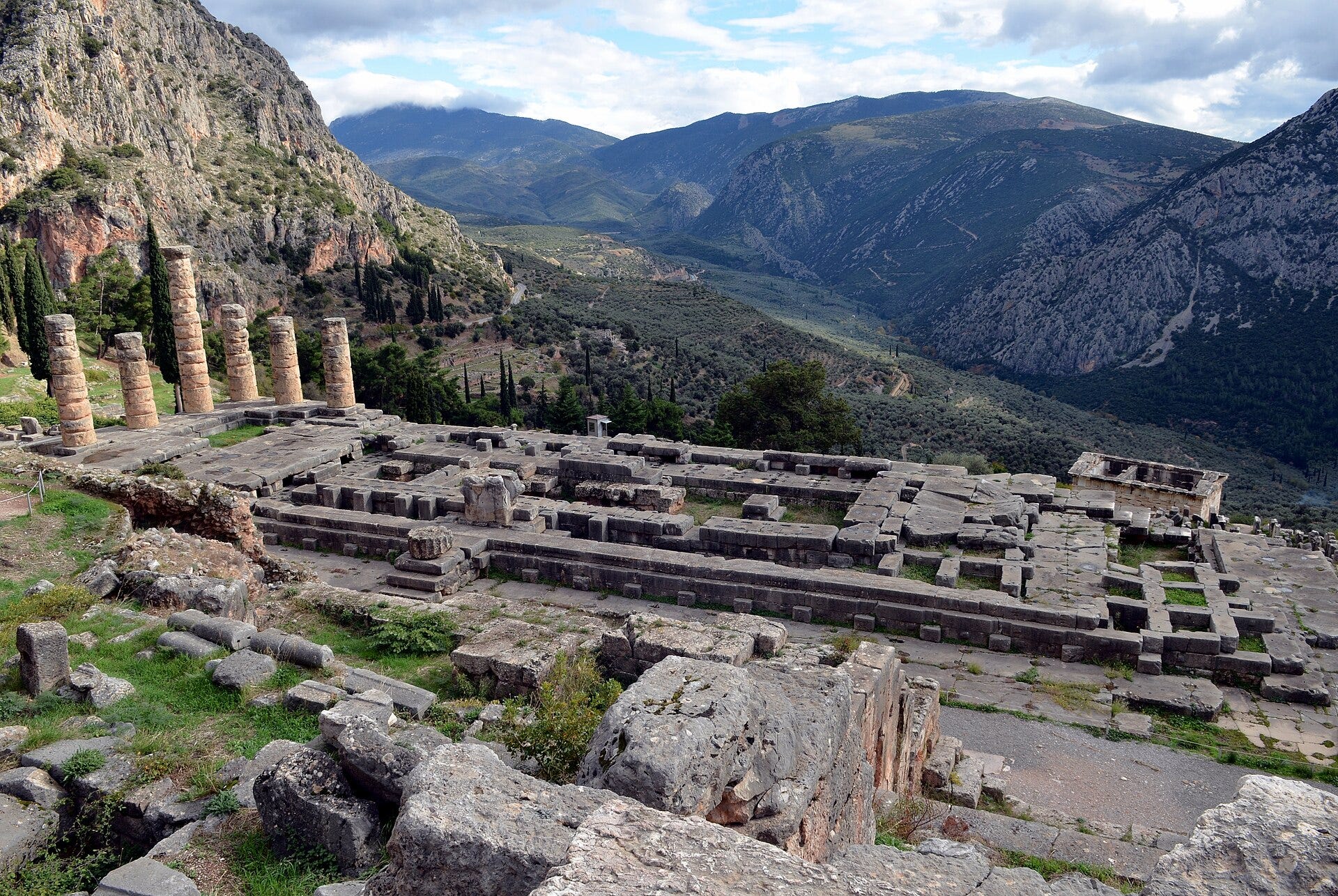
Perched on the slopes of Mount Parnassus in Greece, the Oracle was a priestess who delivered prophecies on behalf of the god Apollo. Kings and generals traveled from across the ancient world to ask her what they should do, and her answers were famously cryptic.
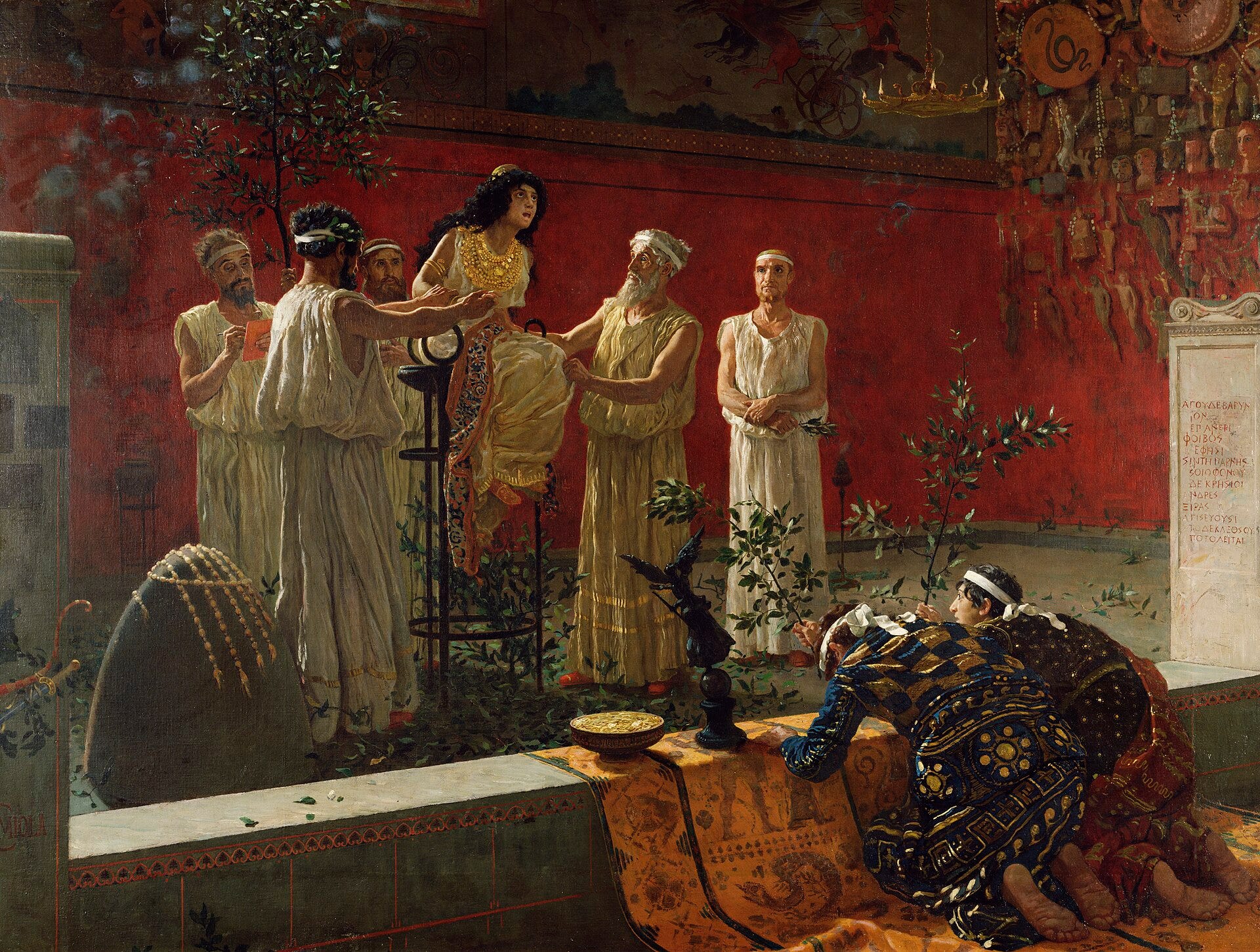
One of the best stories I’ve read about her involves an ancient King, Croesus of Lydia. Before going to war with the Persian Empire, he asked the Oracle what would happen if he attacked. The Oracle answered that if he went to war, he would destroy a great empire. Croesus took that as the sign he was looking for and marched east. And he did destroy a great empire, only it was his own. The Persians made light work of their attack and the Lydian empire soon fell, never to regain power again.
It’s worth noting this idea of tapping into the future spans across not only the polytheistic religions but the monotheistic religions as well. Looking across the main texts of the big three religions of Judaism, Christianity, and Islam, we see numerous references to prophets. Interestingly, these three religions are called the “Abrahamic Faiths” because they all trace their origins back to the Patriarch Abraham, who is often considered one of the foundational prophets.
The one thing they all have in common is a divine commission. Prophets were elevated individuals who were viewed as divinely chosen, thus reinforcing the importance of seeing into the future and communicating it justly. The rest of society relied on these enlightened individuals to provide wisdom and insight.
The Enlightenment
In 1715, Edmond Halley published the first known accurate scientific prediction of a solar eclipse’s path. Using Isaac Newton’s newly established laws of gravity, he mapped exactly where the Moon’s shadow would sweep across England and published it out to the public.
It’s hard to overstate how strange this must have been at the time. Up to that point, eclipses were seen as bad omens or a supernatural signpost that disaster was coming. With no understanding of how the world actually worked, the sun vanishing out of a clear sky was probably a terrifying experience. But Halley accurately predicting the eclipse showed that a new dawn was approaching. We can use science to actually understand how the world around us works.
Going back to Newton, I think this was a turning point in our relationship with the future. He was beginning to lay the foundations of the idea of “classical mechanics”. Put more simply, if you know the exact starting point of something and the forces acting on it, then you can predict where it will go. It’s a turning point because you start to see the idea of: “if we can calculate where things are going, is that not seeing the future?”.
Pierre-Simon Laplace picked up this idea and ran with it. He described a thought experiment in which a hypothetical creature, later nicknamed Laplace’s demon, Could hold all the information of the universe in its mind. Based on classical physics, it would make sense that if you knew the position and movement of every particle in the universe, you could extrapolate the entire history of the universe, and its entire future too.
This caused a lot of people to freak out because it shattered the illusion of free will. If Laplace’s demon could predict the entire future, then it only makes sense that there is one rigid future. We are on “train tracks” so to speak. Our actions are futile because the future has already been decided. This belief is often called “Hard Determinism”, but there are a few issues with it that help us understand the limits of knowing the future.
The Post Modern
The main issue with determinism is that it relied on Newton’s theory applying for the whole of the universe. Even at the level of the atomic particles, you’d need to be able to calculate continuous motion for Laplace’s demon to give us predictions.
Yet in the early 20th century, physicists like Max Planck and Werner Heisenberg discovered that objects at the atomic level move in unpredictable ways. When you drill down far enough, it turns out the world is probabilistic.
This has huge implications for how we think about future now. Think about in your day to day life. We never say it will rain tomorrow. We say, there’s a 60% chance of rain.
Which brings up the next issue: we live in a chaotic world. It’s cliche to say that a butterfly flapping its wings in Brazil causes a tornado in Texas. But I don’t really have a better analogy to use. It’s spot on.
Chaos Theory tells us that no matter how advanced our technology gets, we can never measure the starting conditions precisely enough to forecast reliably very far into the future. What does that mean though? If we have a super sophisticated weather model, we might be able to predict 90% accurately several days out, but there’s an exponential drop off and by day 8 we are only at 50% accuracy. A coin toss.
In theory, Laplace’s demon could predict macro events indefinitely with perfect starting conditions. In practice we never can. We would need infinite precision (think 0.0000000000... and on forever). Even the slightest inaccuracy in the starting condition leads to massive drift over a short period of time.
And these are just for physical systems. What about predicting human behavior? Why does it seem so hard to predict an election? People respond in unpredictable ways depending on social pressure and whether they know they are being observed. And unlike physical systems, the forecast itself can affect the result. For example, more people will show up to vote if they see a tight race forecasted, which in turn changes the outcome.
Forecasting human behavior can be done accurately but only at large scales and only if the behavior is independent of one another. We are pretty good at predicting roughly how many people will watch the super bowl based on previous years, but not the outcome of elections. For the most part, whether I watch the super bowl is not dependent on whether someone in another state will.

So as time goes on, we keep building more and more sophisticated models. We try to predict what people will like, and whether they’ll click a button or not. We use historical data to find trends and patterns and predict what the future holds. But we continue to run up against the same ceilings.
Our world is one of probabilities, not certainties. There is no “future” to predict. Only likelihoods of outcomes.
We have come a long way in our ability to see into the future, and yet, where we’ll go next can’t be known for certain.
Thanks for reading,
Jackson